
—What it is
Wear in the joint that carries the body’s weight
Hip osteoarthritis is the gradual wear of the cartilage that covers the head of the femur and the pelvic bone it sits in. The hip bears the body’s weight and lets the leg bend and rotate; when it wears down, pain, stiffness and reduced mobility appear.
The pain is usually felt in the groin, and sometimes in the thigh or knee, rather than in the hip itself, which delays seeing a doctor. It is more common after age 50, but it also appears earlier when the shape of the joint is altered (such as femoroacetabular impingement or dysplasia), after a previous injury, or with overload or excess weight.
—How it is recognized
Signs people often describe when they come in
- Groin pain when walking, getting up from a chair or climbing stairs.
- Trouble putting on socks or shoes or crossing the leg.
- Stiffness when starting to move, which eases in under half an hour.
- A limp toward the end of the day.
- Pain when turning over in bed.
—Differential diagnosis
What else can hurt in the hip
Not all hip pain is osteoarthritis. Depending on where it is felt, it may be:
- Trochanteric bursitis or gluteal tendinopathy: pain on the outer side of the hip that bothers when lying on that side.
- Pain referred from the lower spine: felt in the buttock or thigh and changing with the posture of the back.
- An inguinal hernia or another abdominal or groin-region cause.
- Avascular necrosis of the femoral head or a stress fracture, which may come on faster and are not always visible on early X-rays.
- An inflammatory arthritis, with prolonged morning stiffness.
—How it is diagnosed
Examining mobility and imaging studies
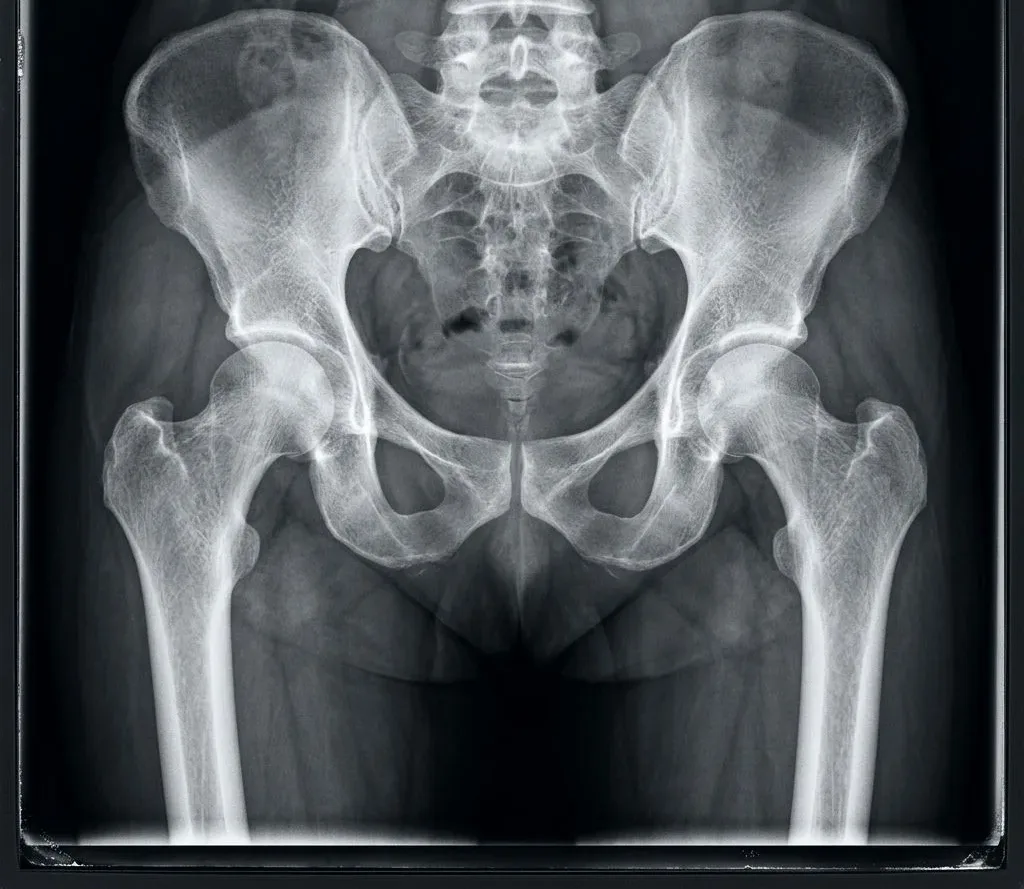
The examination measures range of motion, especially internal rotation, which is usually the first to be limited. A weight-bearing X-ray of the pelvis and hip shows the degree of wear. MRI is kept for when avascular necrosis, a labral injury or a stress fracture is suspected.
—How it is managed
From exercise to a prosthesis, depending on the stage
- Exercise and physical therapy: strengthening the glutes and thigh muscles and keeping mobility is the base of any plan.
- Weight control: every extra kilo adds load to the hip when walking.
- Supports: a cane in the hand opposite the painful hip takes load off the joint.
- Medication prescribed by the physician for pain and inflammation.
- Injections, guided by imaging, which can relieve pain for a while.
- Joint replacement (hip prosthesis), when the wear is advanced, pain limits daily life and the rest is no longer enough. The orthopedic surgeon makes the decision with the patient.
—Regenerative medicine
Our regenerative medicine research does not include the hip
CELAVYX’s line of research in regenerative medicine (PRP, mesenchymal cells and exosomes) is exploratory and is focused on the knee. It is not extrapolated to the hip: we do not offer those therapies for this joint, and there is no evidence that would allow it. What we research and what we do not.
What people ask us most
Can hip osteoarthritis be cured?
It has no definitive cure, but pain and function can be managed with a suitable plan, combining exercise, weight control, medication and, when needed, procedures or surgery.
Why does my groin hurt if the problem is the hip?
Because the hip is a deep joint and its pain projects toward the groin and thigh. That is why it is often mistaken for a groin, back or knee problem.
When is a hip replacement needed?
When the wear is advanced, pain limits daily life or sleep and conservative management is no longer enough. The decision belongs to the orthopedic surgeon, together with the patient.
Do I need to bring studies to the assessment?
If you have X-rays or an MRI of the hip or pelvis, bring them. If not, the specialist will tell you which ones are needed.
—Keep reading